An Epistemological Nightmare
By the Writer
Mr Smith
The Age of Uncertainty — Or Is It?
We have access to more information now than ever before. News, opinions, videos and photographs are available within seconds. Yet the more I see online, the more I wonder how much of it I should believe. It is, in many respects, an epistemological nightmare. I may even start questioning my own existence, and that is dangerous territory.
Ofcom found that four in ten UK adults had encountered misinformation or deepfake content in the previous four weeks. Of those who had encountered false or misleading information, 71% said they had seen it online. Even more interestingly, only 30% felt confident judging whether an image, video or piece of audio had been generated by AI. [1]
We are surrounded by an overwhelming amount of information. Surely, more information should lead to greater certainty. If anything, we appear to have achieved the opposite. Ofcom's research identifies several barriers to recognising misinformation, including AI-generated content, statistics presented out of context and difficulties knowing which sources to trust. [2]
We cannot personally verify every photograph, statistic, or news story we encounter. At some point, we have to decide which sources deserve our trust. My difficulty is that, unless I can examine the origins of the information myself, there will always be a degree of scepticism that cannot quite be shaken.
Do I bestow my trust in a professional news organisation? An expert? Someone with thousands of followers? We know that popularity does not tell us anything about whether something is actually true. I need hard evidence to be certain.
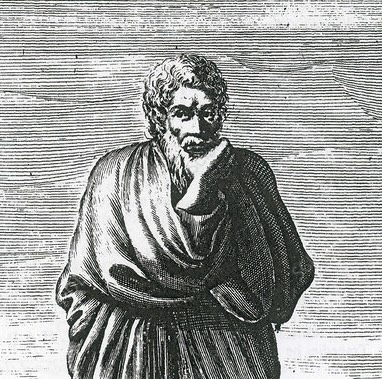
This also taps into our need for certainty. Why do we search for something so fixed in a life that is inherently free-flowing? Heraclitus is often associated with the idea that change is the only constant. If that is true, perhaps certainty was always going to be an illusion.
The only constant in life is change.
Speaking of Change
The problem becomes even more complicated when algorithms determine much of what we see. If we are repeatedly shown information that confirms what we already believe, it can begin to feel true simply because it is familiar.
The Reuters Institute's Digital News Report 2026 found that 62% of people surveyed globally were concerned about what is real and what is fake online. [3] Perhaps that uncertainty is justified considering the technological evolution.
We are often told to question everything. But at what point does questioning become its own form of uncertainty? Perhaps the answer is not to believe everything or nothing, but to become comfortable with what we cannot know. To check our sources, challenge our assumptions and accept that sometimes the most honest answer is simply: “I don't know.”
Further Reading
Ofcom — Four in 10 UK adults encounter misinformation
Read the article
Ofcom — Barriers to identifying mis and disinformation
Read the research
Reuters Institute for the Study of Journalism — Digital News Report 2026
Read the report